Art of Singhal: The Economic Times Profile (1972)
A study of the landmark Economic Times feature published on 25 June 1972, examining Prof. Sukhvir Sanghal's artistic philosophy, Bengal School influences, technical innovations, and major painting series through one of the earliest comprehensive national profiles of his work.
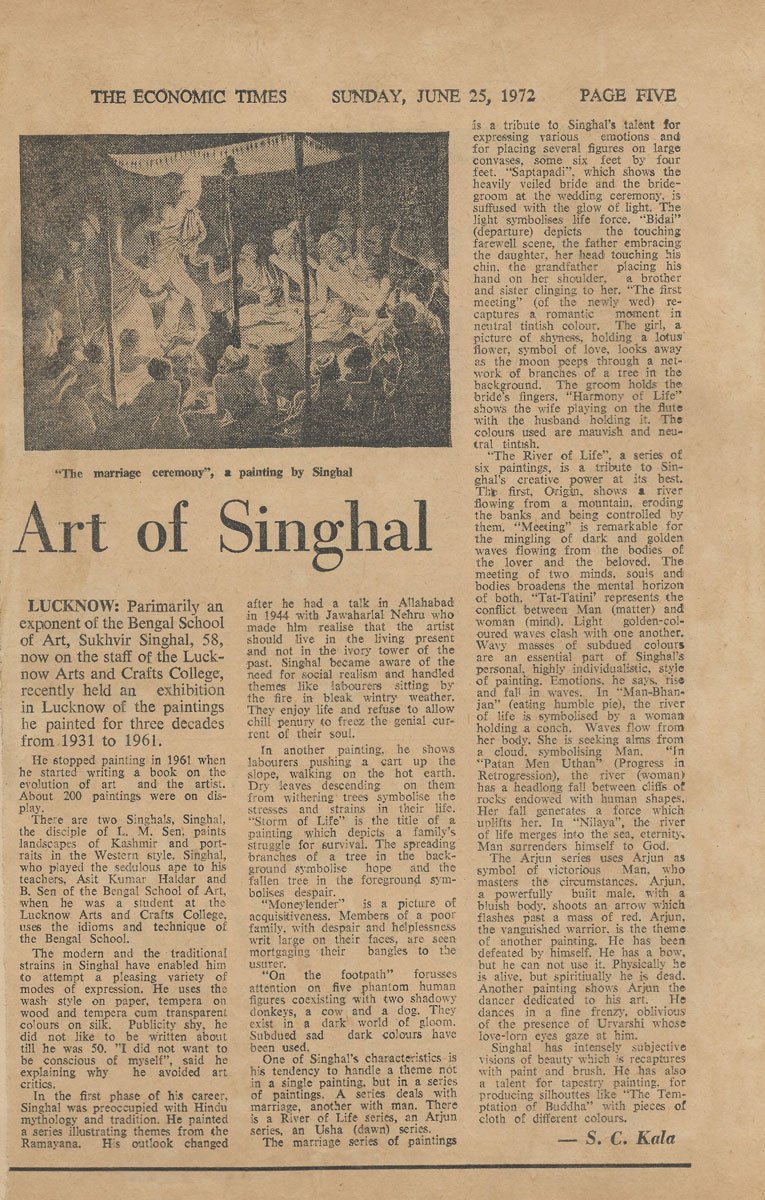
On 25 June 1972, The Economic Times published a full-length feature titled "Art of Singhal," offering one of the most comprehensive contemporary accounts of Prof. Sukhvir Sanghal's artistic philosophy, technical innovations, and creative evolution. Published only weeks after his successful solo exhibition at the State Lalit Kala Akademi, Uttar Pradesh, the article extends beyond conventional exhibition reporting to present a thoughtful profile of the artist and his contribution to modern Indian art. As one of India's leading English-language newspapers, The Economic Times reached a national readership, making the feature an important primary document for understanding how Prof. Sanghal's work was interpreted during his lifetime. Founded in 1961, the newspaper developed a reputation for serious journalism and regularly published features on culture alongside its business coverage.
Introducing an Artist to a National Audience
The article begins by identifying Prof. Sanghal as a distinguished representative of the Bengal School of Art, acknowledging both his artistic lineage and his position as a member of the faculty at the Government College of Arts and Crafts, Lucknow.
Rather than focusing solely on the exhibition, the feature reconstructs the development of Sanghal's artistic career, tracing his work from the early 1930s through more than three decades of creative practice. It presents him not simply as an accomplished painter but as an artist continuously engaged in experimentation, reflection, and the search for new modes of expression.
The Influence of Jawaharlal Nehru
Among the most historically significant aspects of the article is its reference to Prof. Sanghal's conversation with Jawaharlal Nehru in Allahabad in 1944.
According to the feature, this meeting encouraged Sanghal to move beyond idealised historical subjects and engage more directly with contemporary life. The article notes that this marked an important turning point in his artistic outlook, leading him towards themes drawn from ordinary people, social realities, and human experience.
This contemporary account provides valuable documentary evidence for understanding the evolution of Sanghal's artistic philosophy.
An Artist Beyond Publicity
"Publicity shy, he did not like to be written about till he was 50. 'I did not want to be conscious of myself,' said he explaining why he avoided art critics."
One of the most revealing passages in the Economic Times feature describes Prof. Sukhvir Sanghal as "publicity shy." The article notes that he disliked being written about until he was around fifty years of age, explaining simply, "I did not want to be conscious of myself." This statement reflects an artistic philosophy rooted in humility rather than self-promotion. Instead of cultivating public recognition or explaining his work to critics, Sanghal believed that the artist should remain secondary to the artwork itself. His paintings, not his personality, were intended to communicate his ideas, emotions, and philosophy—a characteristic that distinguished both his artistic practice and his approach to public life.
Experimentation Across Media
The feature emphasises that Prof. Sanghal never confined himself to a single medium.
Alongside his mastery of wash painting, the article records his experiments with tempera, watercolour on wood, silk painting, and silk-thread tapestry. These observations reinforce archival evidence that technical innovation formed a defining characteristic of Sanghal's artistic practice.
Rather than treating technique as an end in itself, the article suggests that each medium was chosen to strengthen the emotional and symbolic content of his work.
The Marriage Series and Symbolic Narrative
A substantial portion of the feature is devoted to Prof. Sanghal's celebrated Marriage Series, which interprets the stages of an Indian wedding through symbolic imagery.
The article discusses individual paintings within the series, explaining how each composition represents a particular moment or emotional state rather than merely recording ceremonial events. References to works such as Saptapadi, Bidai, The First Meeting, and Harmony of Life demonstrate the symbolic structure underlying the series and reveal Sanghal's interest in expressing universal human relationships through Indian cultural traditions.
This contemporary interpretation provides valuable insight into how the series was understood by critics during the early 1970s.
River of Life and Philosophical Themes
Beyond the Marriage Series, the feature examines other major bodies of work, including the River of Life series, the Arjun as an ideal man series, and paintings inspired by Indian mythology and philosophy. The reviewer identifies recurring themes of human struggle, hope, spiritual aspiration, and moral conflict, noting that Sanghal increasingly approached painting as a means of exploring psychological and metaphysical questions rather than simply depicting external reality. These observations correspond closely with the philosophical direction that would later define much of Sanghal's mature work.
Contemporary Critical Reception
Unlike a conventional exhibition review, the Economic Times article attempts to explain both the artist and his ideas to a national readership.
It presents Prof. Sanghal as an artist deeply rooted in the Bengal School tradition while simultaneously recognising his originality as an experimental painter and independent thinker. The feature highlights the emotional qualities of his work, the symbolic richness of his compositions, and his lifelong commitment to Indian artistic traditions interpreted through a modern sensibility.
Today, the article remains one of the most informative contemporary newspaper profiles of Prof. Sukhvir Sanghal and serves as an important documentary source for reconstructing his artistic philosophy and career.
Conclusion
More than fifty years after its publication, "Art of Singhal" continues to be an invaluable historical document. It captures how a leading national newspaper introduced Prof. Sukhvir Sanghal's art to its readers, documenting his influences, techniques, major painting series, and philosophical outlook at a significant moment in his career.
Read alongside exhibition catalogues, archival photographs, and contemporary newspaper coverage, the feature contributes to a fuller understanding of Sanghal's place within the history of modern Indian art.
Explore Historical Event →Research & Compilation
Priyam Chandra
Archival Source
View Archival Record →