Prof. Sukhvir Sanghal and the Rathindranath Tagore Gold Medal (1946)
Recognition at the 10th All-India Art Exhibition, Calcutta
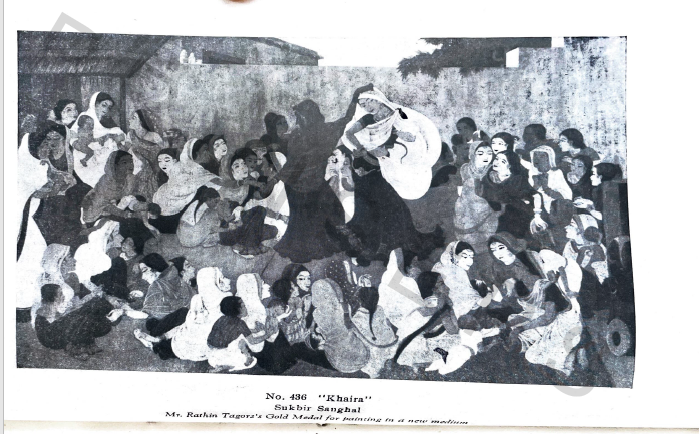
Among the earliest documented national recognitions received by Prof. Sukhvir Sanghal (1914–2006), the Rathindranath Tagore Gold Medal awarded in 1946 occupies a place of exceptional historical significance. Bestowed during the 10th All-India Art Exhibition organized by the Academy of Fine Arts, Calcutta, the medal acknowledged Sanghal's artistic innovation at a remarkably young stage in his career.
Far more than an exhibition prize, the award represented recognition from one of the most influential art institutions in pre-Independence India, judged within the artistic milieu shaped by the Bengal School and the cultural renaissance led by the Tagore family.
The Academy of Fine Arts, Calcutta
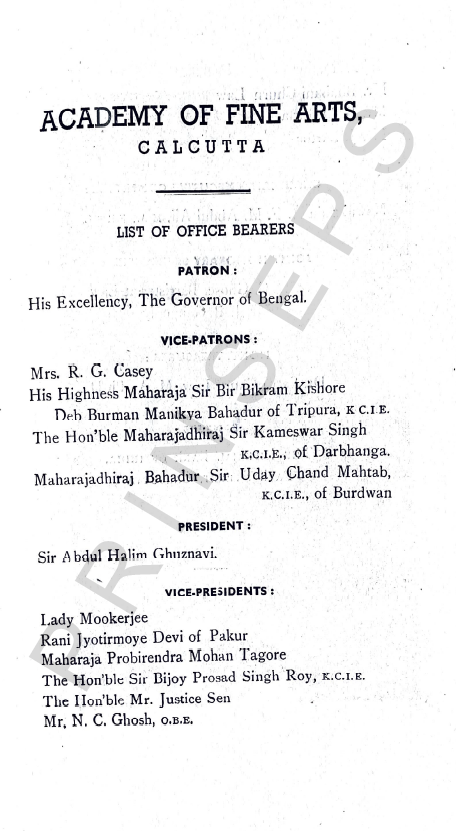
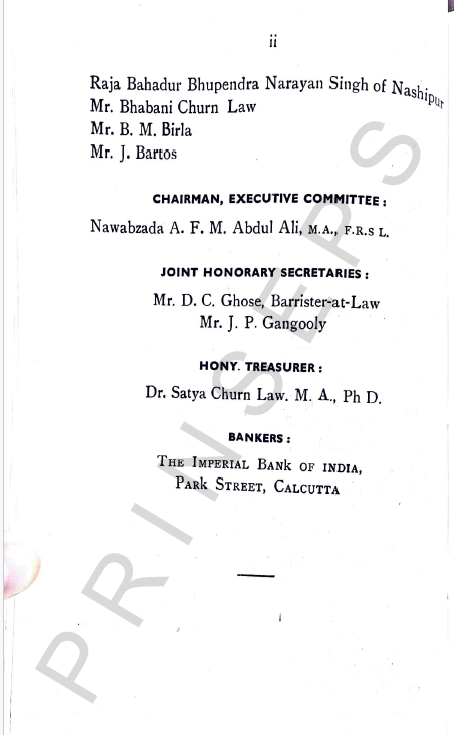
Founded in 1933, the Academy of Fine Arts, Calcutta rapidly emerged as one of India's foremost institutions dedicated to promoting modern Indian art. Its annual exhibitions became national platforms where artists from across British India exhibited alongside established masters.
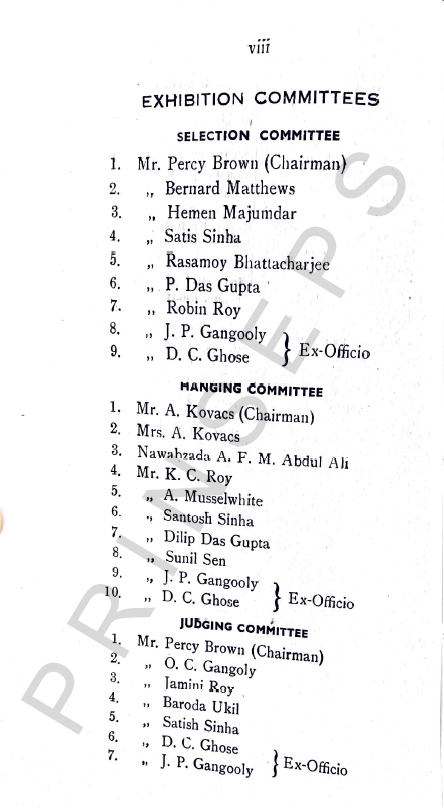
The catalogue of the 10th Annual Exhibition (1946) reveals the stature of the institution.
The exhibition was conducted under the patronage of:
- His Excellency, the Governor of Bengal (Patron)
- Mrs. R.G Casey (Vice-Patron)
- His Highness Maharaja Sir Bir Bikram Kishore (Vice-Patron)
- Deb Burman Manikya Bahadur of Tripura, K.C.I.E (Vice-Patron)
- The Hon'ble Maharajadhiraj Sir Kameshwar Singh K.C.I.E, of Darbhanga (Vice-Patron)
- Maharajadhiraj Bahadur Sir Uday Chand Mahtab, K.C.I.E of Burdwan (Vice-Patron)
- Sir Abdul Halim Ghuznavi (President)
- Maharaja Probirendra Mohan Tagore (Vice-President)
- Justice Sen (Vice-President)
The exhibition was held at the Government School of Art, Chowringhee, Calcutta, from 16–31 January 1946, demonstrating the importance accorded to the event within India's artistic establishment.
The 10th All-India Art Exhibition (1946)
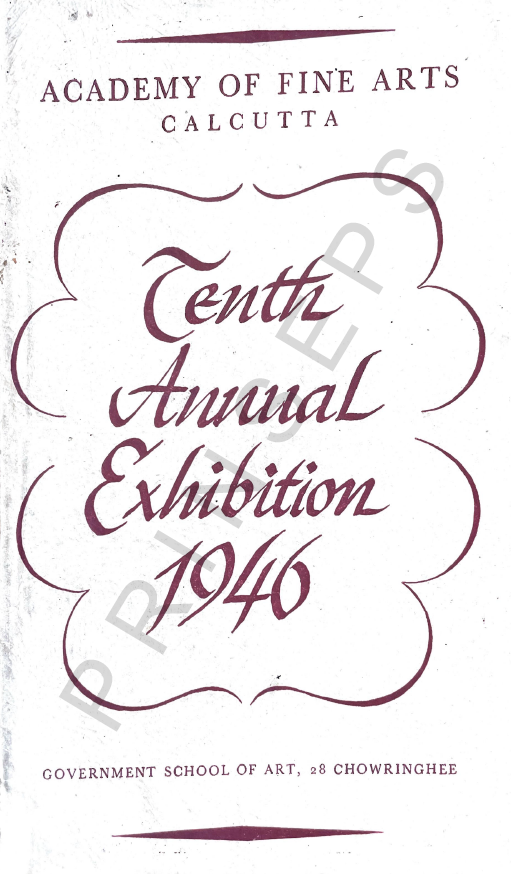
The 1946 exhibition took place during a pivotal moment in Indian history.
India stood on the threshold of Independence, and artists across the country were actively redefining a distinctly Indian visual language. The Academy's annual exhibitions provided one of the few truly national platforms where regional traditions, academic realism, Bengal School ideals, and experimental approaches could be viewed together.
Prof. Sukhvir Sanghal participated in this prestigious exhibition with his painting "Khoria." The exhibition catalogue records:
No. 436 – "Khoria"
Artist: Mr. Sukhvir Sanghal
The inclusion of Khoria within the official catalogue establishes Sanghal's participation in one of the country's leading national exhibitions while he was still in the formative years of his career.
The Rathindranath Tagore Gold Medal
Amrit Bazaar Partika newspaper reports provide important evidence of the honour received by Sanghal.
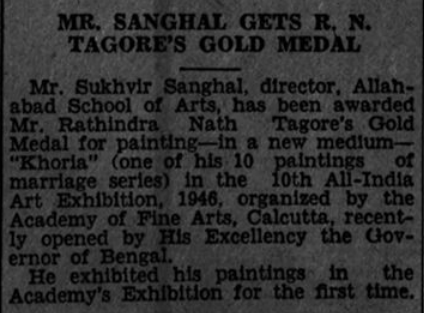
One report announced:
Mr. Sanghal gets R. N. Tagore's Gold Medal.
The article states that:
"Mr. Sukhvir Sanghal, Director, Allahabad School of Arts, has been awarded Mr. Rathindra Nath Tagore's Gold Medal for painting in a new medium—'Khoria'—one of his ten paintings of the Marriage Series in the 10th All-India Art Exhibition, 1946, organized by the Academy of Fine Arts, Calcutta."
The report further notes that this was the first time Sanghal exhibited his paintings at the Academy's annual exhibition.
This contemporary documentation confirms that the award specifically recognised Sanghal's experimentation with a new artistic medium, rather than merely honouring an individual painting.
"Khoria" and Artistic Innovation
The award-winning work, Khoria, formed part of Prof. Sanghal's celebrated Marriage Series, a series of eleven paintings exploring Indian matrimonial rituals and cultural traditions.
Executed on a 73 × 116 cm wooden plywood panel, Khoria comprises more than sixty-five meticulously composed figures. The painting was created using an experimental technique by Prof. Sukhvir Sanghal, known as Lacsit painting, in which watercolour was applied directly to a prepared wooden surface. This innovative process represented one of his earliest technical contributions and laid the foundation for his later development of a distinctive method of watercolour on wood.
Why the Award Matters
The Rathindranath Tagore Gold Medal holds importance for several reasons.
First, it represents one of the earliest nationally documented recognitions of Prof. Sukhvir Sanghal's artistic achievement.
Second, it demonstrates that Sanghal's work attracted attention beyond regional art circles and was acknowledged at one of India's most respected national exhibitions.
Third, the award recognised innovation rather than convention, affirming Sanghal's willingness to experiment with materials and techniques throughout his career.
Finally, the association with Rathindranath Tagore—artist, designer, craftsman, and the eldest son of Rabindranath Tagore—places Sanghal's achievement within the broader intellectual and artistic legacy of the Tagore family, whose influence profoundly shaped twentieth-century Indian art.
Legacy
Although later remembered primarily for his mastery of wash painting and his contributions as an educator, the 1946 Rathindranath Tagore Gold Medal reveals that innovation defined Prof. Sukhvir Sanghal's work from the very beginning of his professional career.
The surviving exhibition catalogue, together with contemporary newspaper documentation, establishes this honour as an important milestone in the history of modern Indian art. It records the moment when a young artist from Allahabad first gained national recognition for creative originality at one of pre-Independence India's most prestigious art exhibitions.
Today, the award stands not merely as an individual achievement but as documentary evidence of Sanghal's early place within the evolving narrative of twentieth-century Indian art.
Research & Compilation
Priyam Chandra
Archival Source
View Archival Record →